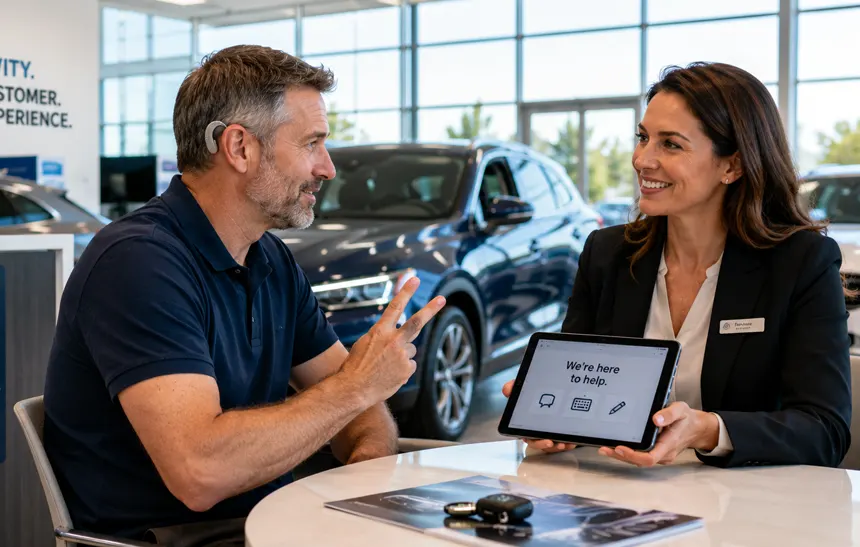
Buying a car is already stressful. Now imagine doing it when every conversation – the test drive debrief, the finance breakdown, the back-and-forth over trade-in value – gets filtered through a noisy showroom and a salesperson who’s looking at a screen instead of your face.
For the roughly 15% of American adults who have some degree of hearing loss, that’s not a hypothetical. It’s Tuesday afternoon at a dealership.
A hearing loop (also called an induction loop or audio induction loop) can change that experience entirely. But most buyers don’t know to ask for one, and most dealerships don’t advertise whether they have one. This guide fixes both problems.
What a Hearing Loop Actually Does
A hearing loop is a thin wire installed around a room – a showroom, a finance office, a service waiting area. It connects to the venue’s sound system and transmits audio directly to a hearing aid or cochlear implant that has a telecoil (T-coil) setting.
No Bluetooth pairing. No app. No asking someone to repeat themselves. The sound goes straight to your device, at the volume and clarity your audiologist set for you.
The telecoil picks up a magnetic signal from the loop, so background noise – PA announcements, other conversations, HVAC hum – drops away. What’s left is just the person talking to you, clear and direct.
For someone with a T-coil-enabled device, it’s one of the best listening environments available.
Why Car Dealerships Are a Particularly Hard Environment
Dealership showrooms are acoustically awful. High ceilings, hard floors, glass walls, and constant foot traffic create exactly the kind of diffuse noise that makes speech hard to follow.
Finance offices are marginally better, but they’re small and often separated from the showroom floor by a thin partition. You’re expected to absorb complex information – interest rates, warranty terms, gap insurance – while someone talks at normal conversational speed across a desk.
Service departments are worst of all. Concrete floors, metal tools, compressors running in the background. A service advisor trying to explain a repair estimate in that environment might as well be whispering.
A hearing loop system in each of these spaces would address the problem directly. The technology costs a few hundred to a few thousand dollars to install per room – a small number relative to a dealership’s overhead – and the benefit to customers is immediate.
How to Find a Car Dealership with a Hearing Loop
There’s no centralized national registry of hearing loop-equipped dealerships in the U.S. or UK. That’s a real gap. In the UK, the RNID (Royal National Institute for Deaf People) maintains some public resources, and the Hearing Link charity has pushed for broader retail adoption, but dealerships aren’t specifically catalogued.
Your best options right now:
Call ahead. Ask specifically: “Do you have an induction loop or hearing loop in your showroom or finance office?” Reception staff may not know the answer immediately, but a well-run dealership will find out for you.
Check the venue’s signage. If a dealership has a loop installed, they should display the international hearing loop symbol – a stylized ear with a “T” – near the entrance or at each equipped location.
Use Google Maps reviews. Search for “[dealership name] + hearing loop” or check if any reviewers have mentioned accessibility. It’s patchy, but sometimes useful.
Contact the manufacturer’s accessibility team. Some OEMs – notably Ford, BMW, and Toyota – have accessibility lines that can flag dealers who’ve invested in assistive listening infrastructure. Results vary by region.
What Good Accessibility Looks Like at a Dealership
A hearing loop is the most effective assistive listening tool for T-coil users, but a genuinely accessible dealership does a few other things well too.
Staff training matters as much as hardware
A loop on the wall means nothing if the sales associate faces away when they talk, speaks too quickly, or doesn’t know how to switch the system on. The best accessibility outcomes come from dealerships where staff have had basic communication training – maintaining eye contact, speaking at a moderate pace, confirming understanding.
Audi’s UK dealer network, for example, started rolling out deaf awareness training across select showrooms in 2022. The results were visible in customer satisfaction data within a year.
Written communication should always be available
For customers who don’t use hearing aids, or whose devices don’t have T-coil, written summaries of finance terms, repair estimates, and contract details are essential. This isn’t just good accessibility practice – it’s good sales practice. Buyers who understand what they’re signing are more satisfied customers.
Video remote interpreting (VRI) is becoming more common
Some larger dealer groups now have tablets or screens available that connect to a sign language interpreter via video. It’s not universal, but it’s growing. If you use ASL or BSL, it’s worth asking whether the dealer has this option before you make the trip.
Hearing Loop vs. Other Assistive Listening Systems
Dealerships sometimes have FM systems or infrared systems instead of a hearing loop. Here’s how they differ:
| System | How It Works | Requires Extra Device? | Works with Hearing Aids? |
|---|---|---|---|
| Hearing Loop (Induction Loop) | Magnetic signal via T-coil | No (if aid has T-coil) | Yes |
| FM System | Radio frequency transmission | Yes (receiver + headphones) | Sometimes |
| Infrared System | Light-based transmission | Yes (receiver) | No |
| Bluetooth Audio | Wireless digital signal | Yes (compatible device) | With newer aids |
For most hearing aid and cochlear implant users, a hearing loop is the simplest and most effective option because it works with equipment you already own. FM and infrared systems require you to pick up a dedicated receiver at the venue – which introduces friction and, honestly, a certain amount of awkwardness in a sales environment.
Your Legal Rights as a Hard of Hearing Car Buyer
In the United States, the Americans with Disabilities Act (ADA) requires businesses to provide “effective communication” to people with disabilities. For hard of hearing customers, this can mean providing assistive listening devices upon request.
The ADA doesn’t specifically mandate hearing loops, but the Department of Justice’s guidance is clear that businesses – including car dealerships – must not exclude people with hearing loss from equal access to their services.
In the UK, the Equality Act 2010 places a “reasonable adjustment” duty on service providers. For a dealership generating millions in annual revenue, installing a hearing loop would likely qualify as reasonable.
If a dealership refuses to accommodate a customer with hearing loss and can’t provide an alternative means of effective communication, that’s worth reporting to the relevant authority – the ADA National Network in the U.S. or the Equality Advisory Support Service in the UK.
FAQs
Do all hearing aids work with a hearing loop?
No. Your hearing aid or cochlear implant needs a telecoil (T-coil) to use an induction loop. Many modern aids have one, but it’s not universal – check with your audiologist if you’re unsure. When the T-coil is active, you’ll usually see a “T” on your device’s setting.
Can I request a hearing loop at a dealership that doesn’t have one?
You can, and under the ADA (U.S.) or Equality Act (UK), they may be required to find an alternative means of effective communication if they can’t provide a loop. This could include written materials, a quieter meeting room, or a remote interpreter.
Are electric vehicle dealerships better on accessibility?
There’s no strong evidence that EV-specific dealerships are systematically more accessible, though some newer showrooms – like certain Tesla gallery formats – are designed with open layouts that can be acoustically cleaner. Tesla also offers text-based communication options through its app.
What should I say when I call a dealership to ask about accessibility?
Be direct: “I have hearing loss and use a hearing aid with a T-coil. Do you have an induction loop system in your showroom or offices?” If the answer is no, ask what alternatives they can offer.
Is a portable hearing loop an option?
Yes. You can buy a personal portable loop (sometimes called a neck loop) that connects to a phone or tablet. If a dealership uses a tablet for presentations, you could use your own device. It’s a workaround, not a solution – but it’s practical.
How common are hearing loops in UK car dealerships vs. U.S. dealerships?
The UK has generally broader hearing loop adoption across retail and service environments, partly because RNID and similar organizations have pushed harder for it. But dealership coverage is still inconsistent in both countries. The infrastructure is there in some franchise showrooms; it’s just not the norm yet.
A dealership that invests in a hearing loop is telling you something about how it treats customers. The technology is affordable, well-understood, and genuinely useful. The fact that most showrooms still don’t have one says more about priorities than budgets.
If you’re hard of hearing and shopping for a car, ask the question. The best dealers will already have an answer ready.
If you want to ready more about automotive articles, visit MagazineStack