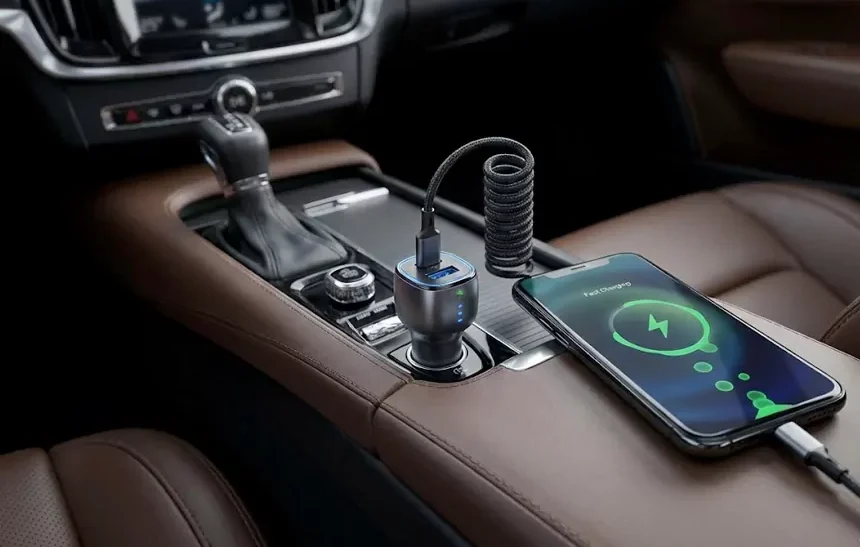
You need a best car charger for fast charging that actually works. The right charger can power your phone from 0% to 50% in under 30 minutes while you drive. Look for models with USB-C Power Delivery or Quick Charge 3.0, at least 30W output, and safety features like overheat protection.
What Fast Charging Technologies Mean
Fast charging technologies tell your charger how to communicate with your device. USB Power Delivery (PD) and Quick Charge (QC) are the two main charging protocols that deliver power faster than standard 5W chargers.
PD uses an advanced communication protocol to negotiate charging voltage and current with your device, allowing faster and more efficient charging up to 100W. QC 3.0 uses Intelligent Negotiation for Optimum Voltage technology to deliver the right amount of power, charging devices up to four times faster than regular chargers. PD works with both iPhones and Android devices, while QC primarily supports Android phones with Qualcomm processors. Modern chargers often support both protocols, giving you flexibility across different devices. QC 3.0 is up to 38% more efficient than QC 2.0 and produces less heat, making it safer for your battery during long drives. These rapid charging technologies represent a significant advancement over the slow charging methods of older automotive power adapters.
How to Choose the Right Fast Car Charger for Your Device
Your device determines which charger works best. iPhones need PD charging, while many Android phones work with either PD or QC.
Check your phone’s specifications first. Apple and Google Pixel phones use PD 3.0 only, while many Android devices support both PD and QC 3.0. Samsung Galaxy phones, for example, charge fastest with PD or their proprietary Super Fast Charging protocol. Look at the wattage your device supports. An iPhone 15 can handle up to 27W, while some Samsung phones support 45W or higher. Match your charger’s power output to your device’s capacity. Buying a 100W charger for a 20W phone won’t hurt anything, but you’re paying for power you can’t use. For tablets and laptops, aim for chargers with 45W or more on at least one port to ensure adequate charging speed. Understanding device compatibility ensures you get the optimal charging performance from your vehicular charging equipment.
Top Fast Charging Car Chargers Recommended
The market offers several reliable in-car power solutions for different needs and budgets in 2025.
The Spigen SteadiBoost is an exceptional car charger offering both QC 3.0 and PD 3.0 charging technologies for under twenty dollars. For higher power needs, the LISEN 90W USB-C car charger features dual USB-C ports delivering 45W each, charging devices from 0 to 83% in just 30 minutes. The Tollefe 78W 5-in-1 proved to be a very capable charger with plenty of ports and quick charging, ideal for families with multiple devices. Budget-conscious buyers should consider the Anker 40W 2-Port PowerIQ charger, which delivers reliable fast charging for two devices simultaneously. These mobile device chargers consistently scored high in independent testing for power output and charging speed. The term “cigarette lighter adapter” historically refers to these chargers because the electrical cigar-lighter was invented and patented in the early 1880s, originally designed for lighting cigars with its 21-millimeter diameter, though today’s 12V accessory socket serves primarily as a universal power outlet for charging electronics.
Comparing Multi-Port vs Single-Port Performance
Multi-port chargers share total wattage across all USB ports. A 90W dual-port charger might deliver 45W per port when both are used, or the full 90W to a single device.
Understanding port distribution helps you pick the right model. Some chargers prioritize one port over others. When you plug in a second device, the first port might drop from 45W to 30W. Read specifications carefully. Look for chargers that maintain high wattage across multiple charging ports simultaneously. The top chargers include both QC and PD technologies, ensuring universal compatibility with various devices. For road trips with family, choose chargers with at least three ports and 60W+ total output so everyone stays charged without fighting over ports. The charging efficiency of multi-port units depends heavily on their smart power allocation features.
Safety Features and Performance Tips
Modern fast chargers include built-in protections that keep your devices safe during charging.
Quality chargers have overheat protection, overcurrent protection, and short-circuit prevention. With ActiveShield 2.0 and MultiProtect, Anker car chargers provide real-time protection by constantly monitoring temperature and power output to prevent damage. These safety certifications matter more than you think. Cheap chargers without proper protection can damage your phone’s battery or even cause fires. Look for certifications from recognized safety organizations. Your charging cable matters too. To achieve super-fast charging speeds, you need a high-quality USB-C cable rated to handle the wattage you intend to use. Cheap cables from gas stations often lack the proper wiring for fast charging, limiting your charger’s performance regardless of its capabilities. These thermal management systems prevent battery degradation and ensure safe power delivery through the 12V DC socket.
Understanding Wattage and Charging Speed
Wattage determines how quickly your device charges. Higher wattage means faster charging, but only up to your device’s maximum capacity.
While your car’s built-in USB port might offer a measly 5 watts, a dedicated fast charger can deliver 20W to 100W or more. A 20W charger can take an iPhone from 0% to 50% in about 30 minutes. A 45W charger does the same for compatible Android phones in 20-25 minutes. But wattage alone doesn’t tell the whole story. Your device’s charging protocol and battery management system control actual charging speed. A phone that supports only 18W charging won’t charge faster with a 65W charger. The extra power sits unused. For most smartphones, a 30W charger provides the sweet spot between speed and cost. Tablets and laptops need 45W or higher for optimal performance. Understanding the relationship between amperage and voltage regulation helps you maximize your charge rate while minimizing energy consumption.
Frequently Asked Questions About Fast Car Chargers
Can I use any fast charger with my phone? Yes, but you’ll only get fast charging if your phone and charger share the same protocol. Modern chargers with both PD and QC work with most devices.
Will fast charging damage my battery? No. Modern smartphones and chargers have built-in safety features that regulate power flow, preventing overcharging or overheating. Quality chargers actually protect battery health better than cheap ones.
Why does my phone charge slowly even with a fast charger? Three common causes: your cable can’t handle the wattage, your phone is hot (devices slow charging when overheated), or you’re using your phone heavily while charging. Try a better cable first.
Do I need separate chargers for iPhone and Android? Not anymore. Most top chargers include both QC and PD technologies, working with both iPhone and Android devices without needing separate chargers. This cross-platform compatibility eliminates the need for brand-specific adapters.
Can a car charger drain my battery when the engine is off? Yes, a cigarette lighter charger can drain your car’s battery if the engine is off, especially if left plugged in for extended periods when the battery is already weak. Unplug when not in use to prevent parasitic drain on your vehicle’s electrical system.
Key Points Summary
5 Valid Points Related to Best Car Charger for Fast Charging:
1. Protocol compatibility matters most – Your charger must support the same fast charging technology (PD or QC) as your device to achieve maximum speed, otherwise you’ll only get standard 5W charging.
2. Cable quality directly affects charging speed – Even the best 100W charger won’t deliver fast charging if you use a cheap cable that can’t handle high wattage, so invest in quality certified cables.
3. Multi-port chargers distribute total wattage – A 90W dual-port charger typically splits power between ports when both are used simultaneously, so understand port prioritization before buying for family use.
4. Safety features prevent device damage – Quality chargers with overheat protection, overcurrent protection, and short-circuit prevention safeguard both your devices and vehicle’s electrical system from potential harm.
5. Wattage requirements vary by device type – Smartphones typically need 20-30W for fast charging, while tablets require 30-45W and laptops need 45-100W to charge efficiently during travel.